Opener Lab
CRATE vs STARE
See which word leaves you with the easier game.
Both words are in the current screen of 182 openers, tested against 2,374 answers. Exact misses rank first; average guesses among wins break ties.
The same solver played from both openers. CRATE has the lower average in games solved within six: 3.46 guesses to 3.50 for STARE.
Looking only at the opening row, CRATE has higher entropy (5.82 bits versus 5.81). That describes first-guess separation, not the full solve on its own.
Against 1,906 past Wordle answers, STARE left the smaller first-guess group on 53% of dates; CRATE did so on 45%, with the rest tied.
| Metric | CRATE | STARE |
|---|---|---|
| Elimination | 96.8% | 96.9% |
| Information | 5.82 bits | 5.81 bits |
| Avg remaining | 76 words | 74 words |
| Avg turns | 3.46 | 3.50 |
| Missed in six | 0 | 0 |
| Win rate | 100.0% | 100.0% |
| Tier (first turn only) | S | S |
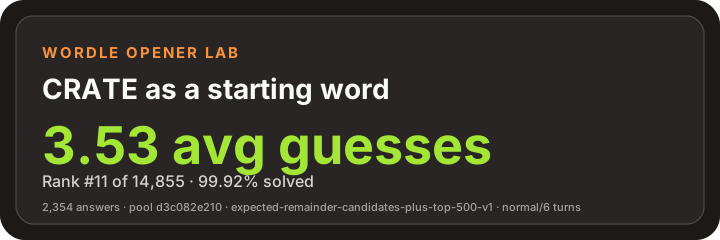
word=crate. Download SVG.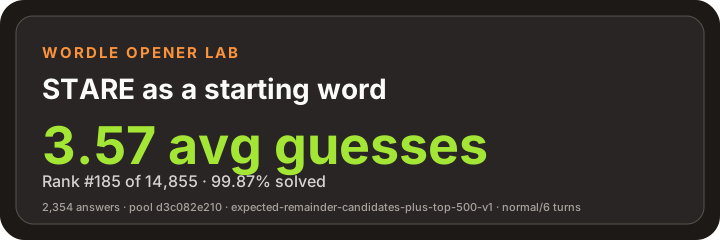
word=stare. Download SVG.Head to head on past answers
We tried both openers against 1,906 past Wordle answers and counted which one left fewer possibilities after the first guess.
Across those answers, CRATE left an average of 72 candidates and STARE an average of 72.
The most recent test was Wordle #1905 on September 6, 2026, when the answer was BEIGE. CRATE came back ⬛⬛⬛⬛🟩 and kept 108 words in play. STARE came back ⬛⬛⬛⬛🟩 and kept 90 words.
What to expect from the first guess
| Outcome | CRATE | STARE |
|---|---|---|
| First-turn solve* | 0.04% | 0.04% |
| At least one green | 43.0% | 41.4% |
| Any green or yellow | 89.3% | 90.1% |
| Whole row gray | 10.7% | 9.9% |
| Worst case answers left | 255 | 235 |
*Treating every word in the possible-answer list as equally likely.
Both openers come back completely gray at almost the same rate, so the difference between them lies in how much their hits actually tell you.
Planning the second guess
After CRATE
All five letters miss 10.7% of the time, leaving 255 words in play. Of the 755 follow-ups checked here, SOILY leaves the fewest possible answers on average (7.1).
After STARE
All five letters miss 9.9% of the time, leaving 235 words in play. Of the 735 follow-ups checked here, COULD leaves the fewest possible answers on average (6.9).
How these two openers fit together
CRATE and STARE share 4 of their 5 letters (A, E, R, T), so as a pair they only cover 6 distinct letters. Treat them as alternatives rather than partners, because playing both wastes most of the second guess.
Played back to back, CRATE then STARE earns 6.94 bits of information in total, 1.12 bits more than the better word manages alone.
Past Wordle answers
- CRATE: Answer to Wordle #45 on August 3, 2021. STARE would have come back ⬛🟨🟩🟨🟩 that day, leaving 5 possible answers.
- STARE: Answer to Wordle #1290 on December 30, 2024. CRATE would have come back ⬛🟨🟩🟨🟩 that day, pinning the answer down on the spot.
Common questions
- Which is a better starting word: CRATE or STARE?
- In the current bounded policy screen, CRATE has the lower average in games the solver finished within six: 3.46 guesses versus 3.50 for STARE. The same solver played from both words.
- What does entropy mean for CRATE vs STARE?
- Entropy measures the information in the distribution of feedback outcomes. CRATE records 5.82 bits and STARE records 5.81 bits. CRATE has the higher score, so its feedback distribution separates the possible answers more effectively on average. Entropy describes the opening row; it does not by itself predict how many guesses a game will take.
- How do CRATE and STARE score against past Wordle answers?
- Across 1,906 past Wordle answers, CRATE left fewer possible answers than STARE on 45% of days, STARE did better on 53%, and the rest were ties. On average, CRATE left 72 candidates after the first guess and STARE left 72.