Color-blind modeAdd patterns so color is not the only cue
Solver display
Show candidates by defaultShow remaining answer candidates in the Solver
Show advanced metricsDisplay detailed word statistics
What “best” means
Rank openers byChoose how the Solver and opener rankings define “best”
Fewest guesses: first maximizes the chance of solving within six, then minimizes average guesses among those wins. Most info: highest entropy on the first guess. Fewest left: smallest average shortlist after the first guess.
Data
Sync profileOptionally keep streaks and progress across devices
Download the open corpus behind the site's opener rankings, difficulty explorer, trap analysis, feedback atlas, and opening-pair research. Every release includes methods, schemas, provenance, and checksums.
Release
v2026-09-01
Published
2026-09-01
Answer history through
2026-08-31
Datasets
12
License
CC BY 4.0 for derived statistics and documentation
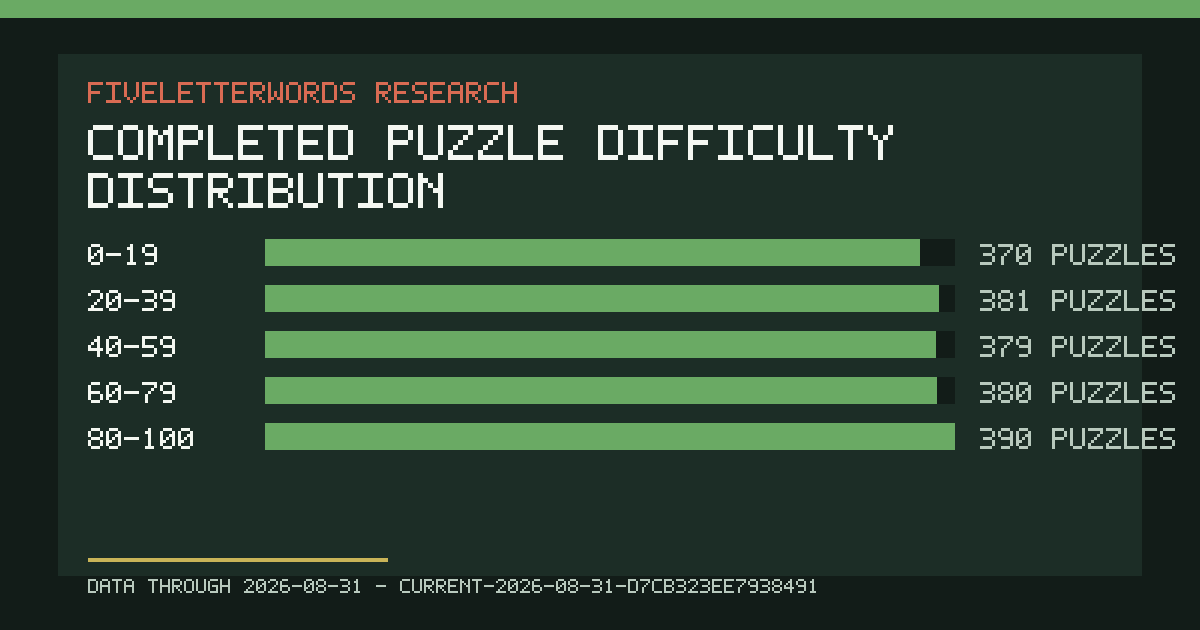
A frozen census of 1,209 completed puzzles, with recurrence counts, an interactive view, aggregate downloads and reproducible methods. Recurrence does not measure player difficulty.
These stories explain published snapshots. Their dates and methods stay attached so a useful clue does not become a claim about every player or today’s puzzle.
A repeated letter can hide in plain sight
In 1,834 distinct completed answers, one fixed solver needed an average of 3.64 turns for words with a repeated letter, compared with 3.45 without one. The gap was about 0.19 turns. A green letter tells you where one copy belongs; it does not promise that another copy is absent.
Source: difficulty study v1, data through 14 July 2026. These are solver routes, not human averages, and the comparison does not establish causation.
The lookalikes matter, not just the rare letters
A one-slot family is a group of words that differ in just one position. In the same study, answers with at least three such lookalikes took 3.62 turns on average, compared with 3.44 for smaller families. Family size also had the largest adjusted association among the four mechanical features studied.
Playing idea: when several words fit, compare the clues a guess could produce. The model explained only 6.3% of the variation, so this is a useful pattern to investigate, not a difficulty forecast.
A large spelling change can be one small sound change
Read this published route aloud: PULLS → POLLS → POSE → CHOSE → CHOKE. POSE to CHOSE replaces only the opening sound in the recorded pronunciation, even though several written letters change. Sound ladders reward listening as well as spelling.
The broad research graph contains 14,402 pronunciation nodes and 54,345 one-sound links. A node groups words that share a primary pronunciation; it is not a count of ordinary words. The playable common-word edition uses a smaller vocabulary.
Source: Echoes graph v1 and its worked route, published 30 August 2026. Links use one insertion, deletion or replacement in primary US-English CMUdict pronunciations. Other accents can give different answers.
v2026-09-01
Download the release
Every table is supplied as CSV and JSON, and every file has a SHA-256 checksum. The preserved answer-pool snapshot is date-free; difficulty rows never include answer words.
Complete normal-mode opener benchmark
Every accepted guess, with six-turn outcomes, turn distributions, and first-guess partition measures.
The research release's complete v5 opener table covers every accepted guess in
its captured snapshot. It is separate from the site's bounded current-policy
recommendations. Average guesses, win rate and volatility come from normal-mode
games capped at six guesses under one fixed continuation policy. Average guesses
and volatility cover solved games; win rate is the share solved within six. Those games use
2,354
possible answers. Entropy and average answers left are separate first-turn calculations over
2,373
possible answers. The manifest records the source files and checksums for both.
The difficulty dataset applies a globally completed cutoff and omits answer words.
Past-answer aggregates never provide a list matching dates to answers. Trap probes
search the documented 2,500-word splitter set; pair results exhaust their published
250-opener candidate universe, not all 110 million accepted-word pairs.
SourcesArchived public Wordle lists, completed daily answers, solver replay paths and versioned feedback calculations.
LimitsResults depend on the captured pools and stated policies. They are reproducible benchmarks, not claims of globally optimal play or representative human averages.
v2026-09-01, published 2026-09-01, contains answer-history aggregates through 2026-08-31. 12 documented datasets · schema version 3.
v2026-07-15, published 2026-07-15, contains answer-history aggregates through 2026-07-14. 10 documented datasets · schema version 3.
v2026-07-13, published 2026-07-13, contains answer-history aggregates through 2026-07-12. 4 documented datasets · schema version 2.
v2026-07-11, published 2026-07-11, contains answer-history aggregates through 2026-07-10. 3 documented datasets · schema version 1.
v2026-07, published 2026-07-09, contains answer-history aggregates through 2026-07-05. 3 documented datasets · schema version 1.
Feeds and citations
Feeds and live embeds
Use the immutable release files for analysis. Use the spoiler-safe feeds and SVG cards when a page, newsletter or dashboard should update automatically.
Answer-repeat timeline<img src="https://www.fiveletterwords.io/embed/wordle-answer-repeats.svg" alt="Annual repeats in worldwide-completed Wordle puzzles">
Observatory result card<img src="https://www.fiveletterwords.io/data/observatory/result-distribution.svg" alt="Thresholded result distribution for the self-selected Wordle Observatory sample">
Feed boundaryThe rolling JSON feed intentionally omits answer words; dated answer research belongs in the guarded archive and immutable releases.
Specialized research
Focused studies with their own releases
The What makes a Wordle hard? study tests opener branches, trap families, repeated letters, letter-position rarity and familiarity against pinned example-solver turns across 1,834 distinct completed answers. Its public analysis table omits answer words and ships with a frozen model specification, uncertainty intervals and reusable figure.
The Echoes phoneme-graph study publishes a bounded, versioned analysis of the pronunciation network behind the game. The internal game graph itself remains an implementation detail; cite the documented research release instead.
Research boundaryThe public articles and their versioned downloads are citable. Static game implementation files are not a stable API.
Citation
Cite the specific result
Use the citation below for this release, or cite a specific ranking or guide when
referring to one result.
FiveLetterWords.io (2026-09-01). FiveLetterWords research release v2026-09-01 [Data set]. https://www.fiveletterwords.io/data/releases/v2026-09-01/
Check a result
The downloadable manifest records the inputs, checksums and calculation scope for this release. The Math explains the scoring, and the About page has contact details for reporting a discrepancy.