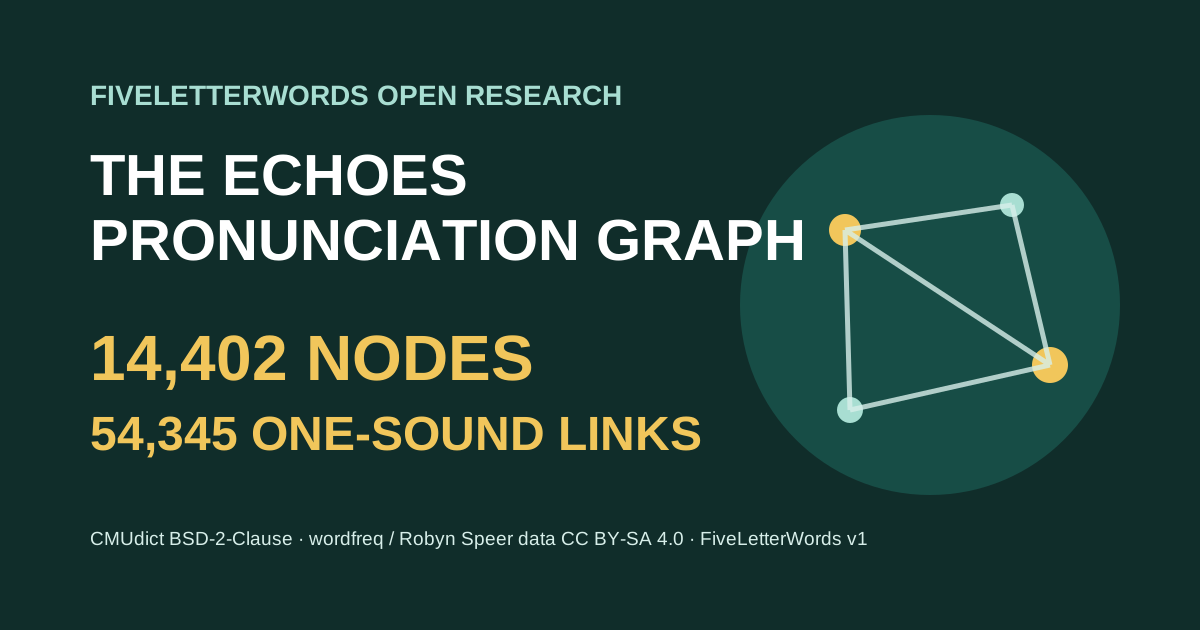
Think of pronunciation as a map. Each sound sequence is a place on the map. Two places connect when you can change one speech sound to travel between them. That simple rule creates the network behind Echoes.
A route can make a surprising jump in spelling while moving only one sound. In the published example below, POSE becomes CHOSE by replacing the first phoneme. That is the reason to listen to the displayed pronunciation before judging a move by its letters.
These figures describe the broad, frozen v1 research graph published 2026-08-30. The playable common-word edition now uses a smaller vocabulary, so a path in the research map is not a promise that every intermediate word is offered in today’s game. The release files and their original methods stay unchanged.
A phoneme is one speech sound. We remove stress marks from each primary CMUdict pronunciation, then connect two nodes only when one sound sequence can become the other by inserting, deleting or replacing exactly one phoneme.
Homophones share a node because they sound the same in this dictionary. Spelling may change a lot across one sound hop, while two similarly spelled words may not connect at all.
It cannot represent every accent, alternate pronunciation, inflection or English word. The common-word threshold and safety exclusions also shape the available paths. A missing link describes this released dataset, not every speaker's pronunciation.
Worked route: PULLS → POLLS → POSE → CHOSE → CHOKE. Each step changes one phoneme in the released dictionary pronunciation.
Try a sound route
Walk from PULLS to CHOKE
Reveal one hop at a time. Read the words aloud, then compare your pronunciation with the pinned US-English dictionary route.
PULLSStart
POLLSReplace one sound
POSEDelete one sound
CHOSEReplace one sound
CHOKEReplace one sound
Reusable figure
The released graph at a glance
Download SVG · Download PNG. Both carry the release scope; retain the source line when reusing them.
The sample begins at CAT and includes every node one phoneme edit away, plus all links among those 38 nodes. It is small enough to inspect in a lesson or code example. It is not a replacement for the complete internal graph.
Released pronunciation nodes one sound edit away from CAT
Displayed word
Pronunciation
Distance from CAT
BAT
B AE T
1
CAB
K AE B
1
CAD
K AE D
1
CADGE
K AE JH
1
CAL
K AE L
1
CALF
K AE F
1
CAM
K AE M
1
CAN
K AE N
1
CANT
K AE N T
1
CAP
K AE P
1
CAPPED
K AE P T
1
CAS
K AE S
1
Classroom-ready activity
Build a four-hop sound ladder
The two-page A4 sheet asks students to order the route from PULLS to CHOKE and name the sound added, removed or replaced at each step. It also asks them to compare the dictionary evidence with accents spoken in the room. Page two gives the route, a 20-minute lesson, sources, licence, method and data cutoff.
The graph universe includes accepted five-letter CMUdict words plus common 3–7-letter CMUdict words at wordfreq Zipf 3.2 or above. The sheet uses primary US-English dictionary pronunciations as one inspectable source, not as a correctness test for every accent.
Immutable release v1
Downloads, methods and checksums
The manifest binds every artifact to a SHA-256 checksum and records its licence. Graph-derived tables, samples, figures and worksheets are CC BY-SA 4.0; standalone original documentation is CC BY 4.0; CMUdict source material remains BSD-2-Clause. Creator credit is required for the Creative Commons files, but no hyperlink is required.