Color-blind modeAdd patterns so color is not the only cue
Solver display
Show candidates by defaultShow remaining answer candidates in the Solver
Show advanced metricsDisplay detailed word statistics
What “best” means
Rank openers byChoose how the Solver and opener rankings define “best”
Fewest guesses: first maximizes the chance of solving within six, then minimizes average guesses among those wins. Most info: highest entropy on the first guess. Fewest left: smallest average shortlist after the first guess.
Data
Sync profileOptionally keep streaks and progress across devices
We asked a simple question: which word features tend to make one fixed solver take longer? Across 1,834 distinct completed answers, trap families, repeated letters, large opening groups and unusual letter positions were each linked with more turns. Even together, they explained only 6.3% of the variation.
The outcome is the number of turns in one fixed example-solver route. That lets us compare words on the same ruler. It is not a global player average, and it cannot prove that any feature causes difficulty. The downloadable table includes solver pressure only as a cross-reference. That score uses some of the same ingredients, so it cannot independently confirm the result.
Start with the language
Six terms you need for this page
Association: two measurements tend to move together. This does not prove that one causes the other.
Adjusted: the comparison holds the other listed features fixed as far as this model can.
95% interval: a range produced by repeated resampling. A wide range means the estimate is less precise.
R²: the share of outcome variation described by the model. Here, most variation remains outside the model.
Standard deviation: a measure of the usual spread around an average. It lets unlike features use one comparison scale.
Beta: the adjusted link on that shared scale. A beta of +0.19 is not 0.19 turns; it says the feature and outcome tend to rise together by comparable fractions of their usual spread.
The findings and coefficient table below give every estimate and its uncertainty interval.
Explore the model
Compare one feature at a time
Each beta puts the feature and solver turns on the shared scale defined above. Larger positive values are linked with longer solver routes in this model.
Fixed-release findings
No single feature tells the whole story
Largest adjusted association
One-slot trap families led the four-feature model
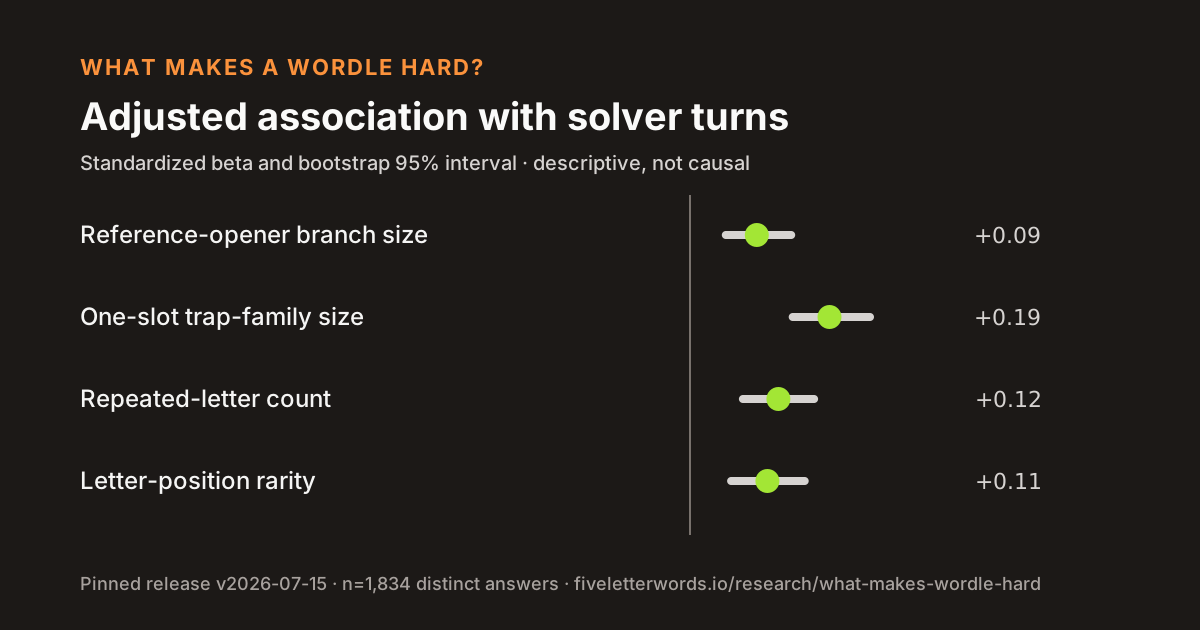
After adjusting for the other three mechanical features, a one-standard-deviation increase in trap-family size was linked with +0.19 solver-turn standard deviations. Family size uses a log₂ scale, where each step represents a doubling. The bootstrap 95% interval was +0.14 to +0.24.
In raw groups, answers in families of three or more took 0.18 more turns on average than one- or two-word families (95% interval 0.13 to 0.24).
Large opening branches added about a fifth of a turn
The largest quarter, or quartile, of mean candidate groups after CRANE, SLATE and ADIEU took 0.22 more solver turns than the smallest quarter. Its bootstrap 95% interval was 0.14 to 0.29 turns.
This is a comparison of three fixed reference guesses. It does not say those are the only sensible openers or that every player follows the same route.
Duplicate letters were a modest, consistent obstacle
Answers containing a repeated letter took 0.19 more turns on average than answers without one (95% interval 0.13 to 0.25). Their adjusted standardized coefficient was +0.12.
The count says that repetition carries information cost in this solver setting; it does not imply that every doubled-letter puzzle is hard.
Standardized coefficients from ordinary least squares (OLS), a common line-fitting method; bars are seeded row-bootstrap 95% intervals. n=1,834 distinct answers; source v2026-07-15; data through 2026-07-14; CC BY 4.0. Descriptive, not causal.
Embed this figure<img src="https://www.fiveletterwords.io/data/wordle-difficulty-study/v1/model-effects.svg" alt="Adjusted associations with example-solver turns across 1,834 distinct completed Wordle answers">
Each beta puts the feature and solver turns onto the same standard-deviation scale. This makes their sizes comparable. A positive value points toward longer routes after the other listed features are held fixed. The model's R² is 0.063, so most word-to-word variation remains unexplained.
Adjusted feature associations and their bootstrap uncertainty intervals
Feature
Adjusted beta
Bootstrap 95% interval
Reference-opener branch size
+0.091
+0.049 to +0.138
One-slot trap-family size
+0.190
+0.140 to +0.245
Repeated-letter count
+0.120
+0.072 to +0.169
Letter-position rarity
+0.105
+0.056 to +0.156
Human-performance boundary
Observatory outcomes were not analysed in v1
No immutable, threshold-cleared production Observatory snapshot was checked into this release. Self-selected human outcomes were therefore not substituted with local or thin data.
When a closed-month production snapshot clears every published privacy threshold, it can be analysed as a separate, explicitly self-selected comparison. It will not be merged into the solver outcome.
Association is not causation, and correlated word features are not isolated experiments.
The solver route and answer universe are pinned to v2026-07-15.
Familiarity covers 732 of 1,834 observations.
The analysis is answer-word-free publicly, but source reconstruction still depends on the pinned private mapping hash.
R² of 6.3% means these features leave most variation unexplained.
Immutable v1 packet
Data, results, methods and checksums
The public analysis table contains dates, puzzle numbers, predictors and outcomes but no answer words. Every file is checksum-bound in the manifest. Derived artifacts are CC BY 4.0; the methods retain the Glasgow Norms attribution and the upstream answer-pool boundary.
FiveLetterWords (2026). What makes a Wordle hard? A reproducible solver study, v1. FiveLetterWords. https://www.fiveletterwords.io/research/what-makes-wordle-hard
For a methods question, correction or custom aggregate cut, use the press and research contact. Corrections are dated publicly; quiet numerical changes are not part of the release model.