Has Wordle Ever Repeated an Answer? Records, Repeats and Oddities
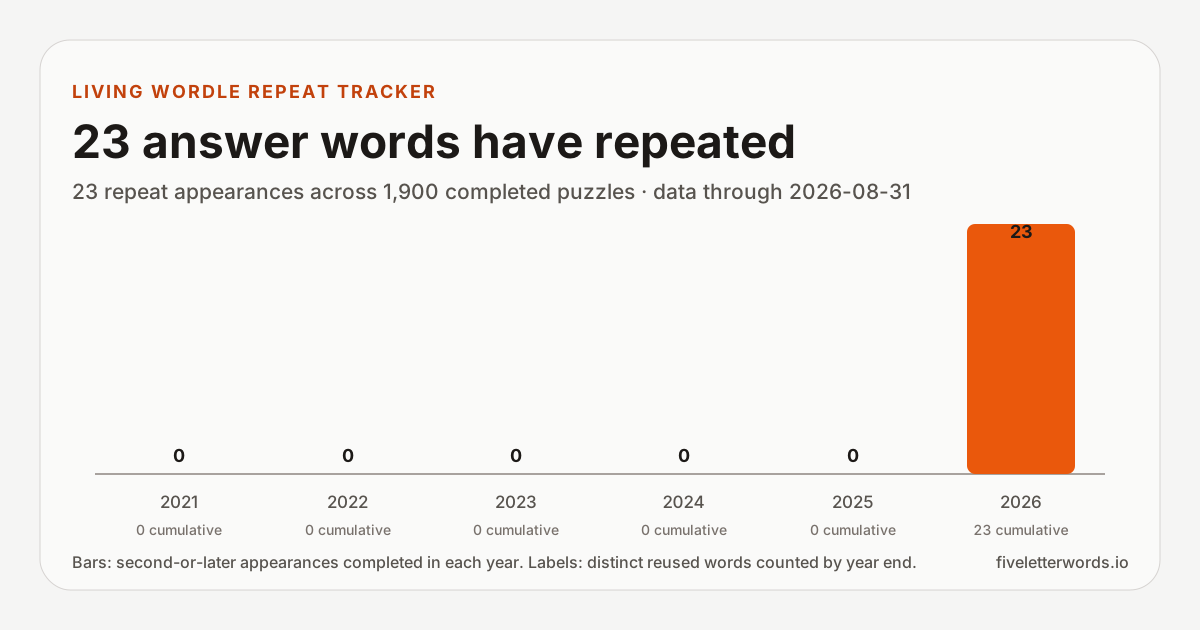
Yes, Wordle answers can repeat. Through , 28 different answer words have been reused. Together they account for 28 second or later appearances.
That gives us one useful rule: do not cross out a candidate only because it appeared in the past. The archive is evidence about what has happened, not a schedule of what will happen next.
Which individual answers were the most and least difficult ever is measured on its own page, ranked by the solver-difficulty percentile.
See the ranked answersHow we tested this
The page covers 1,952 completed puzzle dates and 1,924 distinct answer words from 19 June 2021 to 22 October 2026. A “repeat appearance” is a word's second or later completed use. A “reused word” counts once, even if it eventually appears three times. Gaps run from the first recorded date to the latest. The no-AEIOU count treats Y separately. A hard-day streak uses percentile 65, the difficulty explorer's “Tricky” cutoff.
The living Wordle repeat tracker
MAJOR holds the longest recorded wait from its first appearance to its latest: first seen on 9 July 2021, it returned on 9 October 2026, about 5.3 years later. STINK and FEIGN follow close behind. In the recorded period, 28 distinct words recur, producing 28 second-or-later appearances, and no word appears more than twice.
The repeat table below is ordered by the gap between each word's first and latest recorded appearances.
Why repeat totals can look different
Two reports may use different start dates or treat the original pre-NYT period differently. They may also count two different things: repeat appearances or distinct reused words. That is why two correct reports can show different repeat totals. This tracker states both units and uses one recorded answer for every globally completed date from 19 June 2021 through the cutoff above.
Answers without AEIOU, and answers with doubles
Only 8 recorded answers avoid A, E, I, O and U: CRYPT, DRYLY, GLYPH, MYRRH, NYMPH, PSYCH, SHYLY and TRYST. Every one uses Y as its vowel sound. Doubled letters are much more ordinary. They occur in 600 distinct answers, or 31% of the set.
J appears 22 times, Q 27, X 33 and Z 37 times. In fact, 94% of distinct answers contain none of those four letters.
Answers built from the scarcest letters
For each word, we ask how many other archived answers contain each of its letters. A low mean share means the whole set of letters is unusual. Those letters are weak blind tests early in a game, but a rare yellow can shrink the candidate list quickly.
| Word | First seen | Scarcest letter | Answers containing it | Mean letter share |
|---|---|---|---|---|
| FUZZY | 28 February 2025 | Z | 31 | 11.6% |
| JUMPY | 10 July 2025 | J | 22 | 13.0% |
| JIFFY | 12 July 2024 | J | 22 | 13.5% |
| FIZZY | 1 April 2026 | Z | 31 | 13.6% |
| JAZZY | 1 June 2023 | J | 22 | 14.7% |
| PUFFY | 3 May 2026 | F | 170 | 14.9% |
For example, a mean letter share of 40% means each distinct letter appears in two archived answers out of five, on average. This is a property of the archive's letters. It is not a measure of how common the word is in English.
Hard-day streaks in the archive
A streak here means consecutive puzzles at solver-difficulty percentile 65 or higher. A three-day streak is simply three recorded days in a row above that threshold. It does not show that an editor planned a difficult run, and it does not claim every player found those days equally hard.
| Days | From | To | Puzzles |
|---|---|---|---|
| 7 | 18 July 2026 | 24 July 2026 | BOOTH (66), CHURN (83), DIVER (76), SHILL (94), LORRY (86), ORBIT (65), PUTTY (95) |
| 6 | 21 October 2024 | 26 October 2024 | SPOON (82), SHOUT (67), GOOFY (98), BOSSY (93), FROWN (89), WREAK (71) |
| 6 | 10 May 2026 | 15 May 2026 | PARKA (93), NEWLY (73), CLOCK (74), DOWDY (96), WAVER (88), CREED (70) |
The number in parentheses is each puzzle's percentile. These runs contain several consecutive answers with above-average solver pressure.
Year by year: compare carefully
“Repeats closed” counts second or later appearances in that calendar year. “Scarcest-letter answer” means the year's word built from letters that occur in the fewest other archived answers.
| Year | Puzzles | Repeated-letter share | Repeats closed | Scarcest-letter answer |
|---|---|---|---|---|
| 2021 | 196 | 34% | 0 | BOOZY (Z is in 31 answers) |
| 2022 | 365 | 28% | 0 | BUGGY (B is in 221 answers) |
| 2023 | 365 | 28% | 0 | JAZZY (J is in 22 answers) |
| 2024 | 366 | 27% | 0 | JIFFY (J is in 22 answers) |
| 2025 | 365 | 35% | 0 | FUZZY (Z is in 31 answers) |
| 2026 | 295 | 36% | 28 | FIZZY (Z is in 31 answers) |
The first and current years contain fewer puzzles, so compare shares rather than raw counts. Repeated-letter shares stay close to the archive-wide 31%, with no clear year-by-year shift.
What the archive can teach you
- Balance vowels and consonants. Four vowels may look efficient, but common consonants often divide the shortlist more clearly.
- Do not fish for rare letters without a clue. 94% of these distinct answers contain none of J, Q, X or Z.
- Keep old answers in the candidate list. The repeat table proves that a previous appearance is not a permanent exclusion.
The word finder searches the Wordle guess list for words matching a pattern.
Explore the record
Choose a repeated answer
Compare the number of appearances with the time between the first and latest one.
Find the words that fit any pattern.
Open the Word Finder